

It’s a relatively new phenomenon that a growing percentage of consumers now care a great deal about where their products come from, how they’re made, and whether the manufacturing and packaging and transportation of said goods have any positive impact on their communities. Gone are the days when distance was equated with high taste and exoticism. “Made in America” is no longer a catchphrase for the nationalist set. Nowadays, more and more people don’t just expect domestic goods; they would prefer a soup-to-nuts supply chain with as small a radius as possible.
Of course, that’s not possible for every or even most products one might find at their local supermarket or hardware store, to say nothing of the Targets and Wal-Marts of the land. Regardless, supply chain transparency is fast becoming a benchmark for corporations and retail giants, and with that comes an expectation for accountability. Put another way, if a regional chain of Home Depot’s can’t account for which forests supplied the white pine for their overflowing shelves of 2x4’s, you should probably take your business elsewhere. (Home Depot does a respectable job with its ethical sourcing and its avoidance of conflict minerals and embodied slavery, although there is room for improvement on all fronts.)
When it comes to supply chains, in most cases, the smaller the better. People see great value in supporting local artisans and craftspeople, and why wouldn’t they? The same should go not just for the stuff we put in our homes, but the things we use to build them as well.
Massachusetts-based Tridome Structures, a regional player in the production of mass timber products, is rethinking a pathway for urban wood. In late 2025, the company purchased a sawmill in the Boston suburb of Millis, which is now a subsidiary known as TimberWise. This 50,000-square-foot mill has the capacity to produce up to 10,000 board of feet of architectural-grade (non-structural) products per day, using a variety of regional hardwood and softwood species, from Poplar and White Oak to White Pine and Eastern Hemlock, and even some exotic species like Japanese Katsura.
Tridome’s co-founder and director of innovation TJ Thompson estimates that roughly 95% of all the wood milled at TimberWise is sourced within a 30-mile radius of Boston. As I reported earlier this year in Green Building Advisor:
Remarkably enough, all that material sourcing currently comes from just two arborists, which Thompson says is still enough to keep the mill running at full capacity. The remainder of that supply arrives in piecemeal from areas spanning southern Connecticut up to southern Maine.
Thompson grew up in Ontario’s logging country, where he says the sawmills set up for mass production of dimensional lumber won’t take urban forest materials. “Save for a few people with the odd wood-mizer sawmill in their backyard, there’s not a lot of opportunity to take that wood and make it usable in any regard. Our whole facility is very unique.”
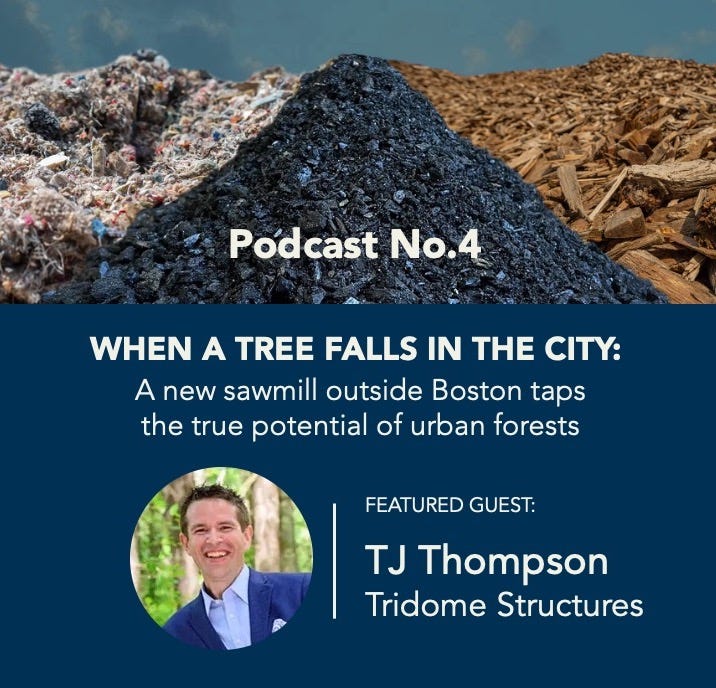
For Episode 4 of Waste to Value, I was enormously pleased to reconnect with Thompson to discuss the logistical challenges of operating an urban-centered sawmill, the appealing character of the wood they source, and how more cities can replicate TimberWise’s model and become better stewards of urban forests.
The new episode will drop Monday, July 13th. Stay tuned.


